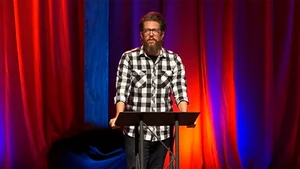
When You Can Finally See Everything, Will You Still Choose Jesus?
To watch the sermon: Refusing to Be Silent (Matthew 20:29–32 Explained)
Download the Discussion Guide: Download
Download the 5 Day Devotional : Download
Two blind men sitting on the side of a road made one of the boldest declarations in all of Scripture. They couldn't see a thing, yet they recognized exactly who Jesus was. That contrast, between those who could see but were blind to what mattered, and those who were blind but could see the truth clearly, is at the heart of what Matthew chapter 20 is really about.
What Is the Difference Between Entitlement and Desperation Before God?
Just before this moment on the Jericho road, James and John (along with their mother) had approached Jesus with a bold request: seats of honor at His right and left hand in the kingdom. They wanted position. They wanted prestige. They had walked with Jesus, witnessed miracles, and heard His teachings, yet they were still wrestling with personal ambition.
Then Matthew introduces two blind men sitting on the roadside. They had no reputation, no position, no influence. They weren't even inside the city gates. They were outcasts by every cultural standard of the day.
But here is what stands out: they didn't approach Jesus with entitlement. They approached Him with utter desperation.
Some of us have spent so much time asking Jesus to elevate our position that we've forgotten He came to transform our hearts. The uncomfortable question worth sitting with is this: when Jesus asks what you want from Him, will your answer reveal your surrender or your ambition?
Why Did the Blind Men Call Jesus "Son of David"?
As Jesus and His disciples traveled the Jericho road toward Jerusalem for Passover, two blind men heard the crowd passing and began shouting, "Lord, Son of David, have mercy on us!"
That title matters more than it might seem at first glance.
They didn't cry out "Son of Man" or "Son of God." They cried out "Son of David," a deeply messianic title. David was one of the greatest rulers in all of Jewish history, a king and military leader whose reign represented some of the most celebrated years of Israel's story. Calling Jesus the Son of David in a Roman-occupied territory was a bold, even dangerous, declaration. It was essentially saying: this is the promised king we have been waiting for.
Two men who could not see a single thing made a prophetic declaration that many of the religious crowd around them had completely missed. They couldn't see with their eyes, but they could see who Jesus truly was.
What Happens When the Crowd Tries to Silence You?
The crowd's response was immediate. Be quiet. Move along. We have somewhere to be.
These blind men were considered a nuisance. In that culture, blindness and illness were often seen as signs of God's curse. The Sadducees taught that what you could see in someone's life was a direct reflection of God's blessing or judgment. So the crowd had every cultural reason to dismiss them.
But the blind men didn't stop. They got louder.
"Lord, Son of David, have mercy on us!"
They refused to be silenced. They didn't argue with the crowd. They didn't get distracted. They pressed in and doubled down. They already couldn't see. They weren't going to let their voice be taken from them too.
The blind men couldn't see, but they could see who Jesus was, while the religious crowd was too busy following Him to fully recognize who He was.
Some people have followed Jesus for decades but haven't let Him interrupt their schedule for even twenty minutes. Don't allow people who can't recognize Jesus to dictate how desperately you pursue Him.
How Does Jesus Respond to Those the World Ignores?
When Jesus heard them, He stopped. He called them over and asked the same question He had just asked James and John: "What do you want me to do for you?"
He didn't treat them like lesser citizens. He treated them with the same respect as His inner circle. In an honor and shame culture, that would have been culturally unthinkable. A rabbi or person of status simply did not show honor to someone considered cursed or unclean.
But Jesus had compassion. And He didn't just speak healing from a distance. He came close and touched their eyes.
He could have simply spoken the word. He had done that before. But Matthew specifically tells us that Jesus came in intimacy and touched them. Nobody touched the blind or the leprous. They were considered unclean. Yet Jesus removed the distance and drew near.
"When Jesus heard them, He stopped and called, 'What do you want me to do for you?' 'Lord,' they said, 'we want to see!' Jesus felt sorry for them and touched their eyes. Instantly they could see! Then they followed him." - Matthew 20:32-34
Are You Good at Identifying Problems Without Getting Close Enough to Help?
The crowd wanted to distance themselves from the blind men. Jesus closed the gap.
It is easy to become very good at identifying people's problems without ever getting close enough to actually help them. The church can identify broken theology, struggling families, and people who seem to have wandered from the faith, all while never getting close enough to understand why someone is in the place they are.
Compassion is not just recognizing that someone is suffering. Compassion requires a willingness to enter into someone else's discomfort.
Jesus, who had all the comfort of heaven, set that aside and came into a broken world. He was beaten, mocked, and flogged. The crowd tried to silence the very people Jesus stopped to save.
Be careful that your version of righteousness doesn't become an obstacle to someone else's redemption. The crowd on the Jericho road wasn't out there disregarding God. They were following His commands, headed to Jerusalem for Passover. But their righteous religious schedule caused them to miss two men that Jesus found important enough to stop for, touch, and restore.
What Is the Real Ending of This Story?
A lot of times when this passage is taught, the focus lands on the miracle itself. And yes, the healing matters. But Matthew chapter 20 doesn't end with the miracle. It ends with a response.
"Then they followed him." - Matthew 20:34
Those three words are the most important part of the story.
These men had just received their sight for the first time. They could have gone and seen every wonder the world had to offer. Nobody would have blamed them. They had been denied sight their entire lives. But they didn't do that. They followed Jesus. They followed Him to Jerusalem, not even knowing they were following Him toward the cross.
The greatest miracle on the Jericho road wasn't that two blind men received their sight. It was that when they could finally see everything this world had to offer, they still chose Jesus.
That is the greatest testimony. They chose Jesus when they could finally see everything.
A lot of people's faith today isn't really about following Jesus. It's about Jesus fitting into what they already have planned. But the question Matthew chapter 20 leaves us with is simple and direct: have you decided to follow Jesus?
Life Application
This week, take an honest look at your current schedule and priorities. Not every moment of your life, just where you are right now. When you wake up in the morning, what gets your first attention? What gets your best energy?
The blind men received everything they had ever been denied, and their first response was to follow Jesus. That is the challenge for this week: make one deliberate choice each day to follow Jesus rather than asking Him to follow you.
It doesn't have to be complicated. It might mean spending time with Him before you open your phone. It might mean asking whether a relationship or habit is drawing you closer to Christ or pulling you away. It might mean getting close enough to someone in need to actually help, rather than just noticing their struggle from a distance.
Ask yourself these questions as you go through the week:
When Jesus asks me what I want from Him, does my answer reveal surrender or ambition?
Am I allowing the crowd around me to silence my pursuit of Jesus?
Is my version of righteousness creating obstacles for someone else's redemption?
Now that I can see clearly what this world offers, am I still choosing to follow Jesus?
The blind men couldn't see, yet they saw Jesus more clearly than anyone else on that road. The question is not whether Jesus can open your eyes. The question is, when He does, will you follow Him?